A three-piece vintage-wash set
Tee, cap and apron sharing one wash and one print language — 900 units built as a set rather than three separate orders that happen to arrive together.
- Market
- Sponsor activations
- Status
- Delivered client work
- Client
- A hospitality group
Named only with the client’s written agreement. Available on request.
- Credits
- Development, sourcing, production management, quality and delivery — Apex Studio. Creative direction by the client.
Challenge
Creative intent
Product architecture
- T-shirt in 270 gsm 100% cotton with screen print
- Cap in 100% cotton brushed twill with embroidery
- Apron in 320 gsm 100% cotton with screen print
- Equal quantities across all three, so the set stays complete
Development approach
- One wash direction defined first, then each base developed to reach it — rather than washing three products and hoping they matched
- Decoration split by substrate — screen print on the flat cotton pieces, embroidery on the brushed twill
- Weights chosen so each piece ages at a similar rate rather than one fading ahead of the others
- Quantities balanced across the three so the set can be issued complete
Materials and techniques
- 270 gsm cotton jersey, 320 gsm cotton canvas and brushed cotton twill
- Vintage fade-out wash applied across all three constructions
- Screen print on the tee and apron, embroidery on the cap
Production route
Quality approach
What was produced
Details
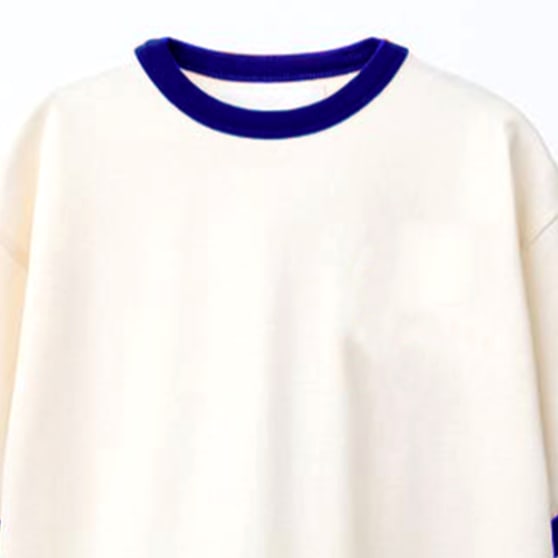
Image pendingPackaging and presentation — box, bag, hangtag, tissue

A set, not three orders
The difference between a set and three products is entirely in the development.
Three separate orders — a tee here, a cap there, an apron from someone else — produce three items that share a logo. Put them on a table together and the fades do not match, the whites are three different whites, and the newest-looking piece makes the other two look tired.
Matching a wash across three substrates
A vintage fade lands differently on 270 gsm jersey, on 320 gsm canvas and on brushed twill. Each base needs its own route to the same destination.
That means defining the destination first — one physical wash standard — and developing each product to reach it, rather than washing three things and comparing the results afterwards. The check that matters is the three pieces side by side, not each one against its own sample.
Decoration follows the substrate
Screen print on the flat cotton pieces, embroidery on the brushed twill. Both trialled on washed bases, because a fade-out wash applied over decoration is a different result from one applied under it.
Small decisions, all of them made before bulk. They are the reason the set reads as a set.
Permissions
Published without naming the client pending written approval. No brand marks or artwork are reproduced here. Commercial terms are not disclosed.
More work
A fashion label's football collaboration programme
Four drops in twenty days — 30 order lines and 13,784 units across jersey, fleece, nylon outerwear and embroidered bombers, for a fashion label working with two European football clubs.
An athlete's signature collection
A washed hoodie and tee programme with matching headwear and jacquard socks — 6,200 units across eight styles, built around two finishes and a single delivery date.
A full lifestyle capsule for a football brand
Fifteen order lines in one production window — tanks, tees, polos, a tracksuit family, headwear, socks, a tote and a bandana, all carrying the same label and trim system.